The Hallmark Myth: What a Small Stamp Can and Cannot Tell You
Learn what a silver hallmark can tell you about a mark and its limits, so you can read a silver object more carefully without mistaking a stamp for its history.
What does a silver hallmark actually tell you? A small stamp on a spoon may point to a maker or marking authority, but it cannot name the spoon’s owner or explain how it reached the drawer. The myth is that a hallmark tells an object’s whole story; it records only the details encoded by the marking system used at the time.
What does a silver hallmark record?
Depending on the place, period and rules in force, marks may indicate a metal standard, a maker or sponsor, an assay office, or a date associated with marking. Not every object carries every type of mark, and worn or incomplete impressions can make identification uncertain.
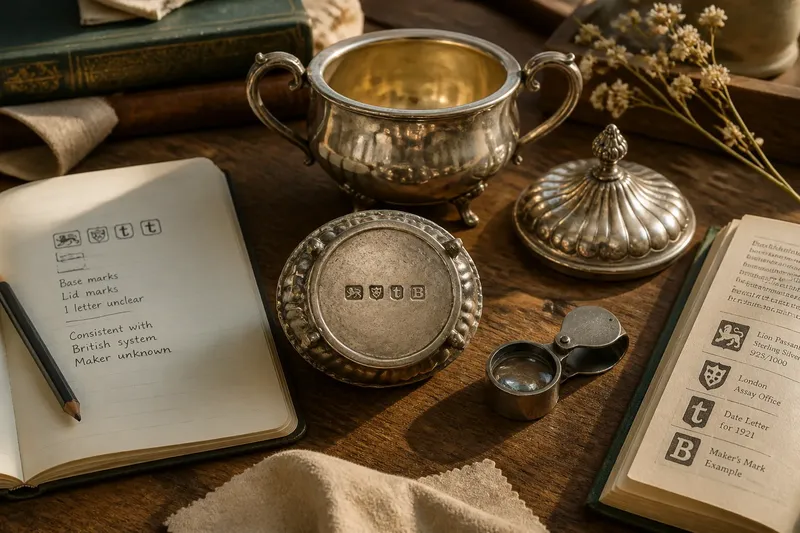
British hallmark groupings vary across periods and systems. In many familiar examples, marks can include a maker’s or sponsor’s mark, a standard mark and an assay-office mark; some groupings also include a date letter. The symbols and their meanings should be checked against a reference for the relevant period and office, rather than treated as a universal code.
A hallmark is rather like a luggage tag: it can identify a limited part of an object’s passage through a marking system, but it is not a diary of every journey afterwards.
Does a hallmark prove every part is silver?
No. A mark may apply to a particular component or to an object assessed under a particular standard. Handles, blades, liners, fittings and later repairs may be made from other materials. A detachable lid’s mark, for instance, does not by itself establish the composition of the vessel beneath it.
Look at the construction as well as the stamp. Seams, joins, detachable parts and contrasting surfaces can raise useful questions, but visual clues cannot settle metal content. For a material identification or a decision that depends on the applicable marking rules, ask a qualified silver specialist or consult relevant official guidance.
If an impression is hard to see, photograph it in soft, angled light and use a magnifying glass. Avoid scraping or abrasive polishing: either can damage the surface and blur details that may help with identification.
Can a silver hallmark name the maker?
Sometimes. A maker’s or sponsor’s mark may be linked to a person, workshop, retailer or firm, and similar initials can belong to different businesses. The shape and position of the mark, its companions and the object’s form all matter.
Compare the impression with a reputable reference for the likely place and period. Check whether the letters and accompanying symbols fit together, and whether the construction is consistent with that reading. A plausible match narrows the possibilities; it does not turn a worn or ambiguous stamp into a certain attribution.
Say you inherit a small sugar bowl with two clear symbols and blurred initials. You photograph the marks, note that one is on the base and the others sit beside it, then compare the visible symbols with a reference for the apparent marking system. The symbols point towards a likely system, but the initials remain unclear, so the resulting note names the system as a possibility and leaves the maker unidentified.
How should you record a silver hallmark?
Separate what you can see from what you think it means. This simple record makes later comparisons easier and keeps uncertain readings from turning into facts.
- Check the mark’s location: note whether it is on the base, rim, handle or a separate fitting. If it is on a detachable part, then record that part separately; otherwise, note that the mark is on the main body.
- Check the visible characters: write down legible letters, symbols and outlines, leaving worn areas blank. If a character is unclear, then mark it as uncertain rather than supplying a guess; if it is clear, record it as seen.
- Check the object’s construction: note seams, joins and detachable components, and photograph the whole object. If the mark is on one component, then limit your reading to that component; if the object is assembled, record the other parts separately.
- Check the order and spacing: record how the marks sit in relation to one another. If they form a recognisable group in the relevant reference, then compare them as a group; if not, assess each mark cautiously.
- Check the reference’s place and period: use a source that matches the likely marking system. If its symbols and dates fit the visible marks, then note the match as a supported possibility; if they conflict, look for another system rather than forcing the identification.
- Check the impression before cleaning: photograph it in angled light and keep the surface dry. If the detail is already visible, then stop; if it remains unreadable, seek specialist advice instead of using an abrasive cleaner.
Imagine you are recording a small bowl with a base mark, a detachable lid and one blurred letter. First, you photograph the whole bowl and each component, then write down the clear symbols without filling in the letter. Next, you consult a reference for the apparent marking system; if its grouping fits, your record can say “consistent with that system”, while the maker remains unknown. The trade-off is straightforward: a narrower, honest identification is more useful than a complete-sounding answer built on an unreadable character.
What questions can a silver hallmark answer only partly?
Can a silver hallmark tell you who owned the object?
No. A hallmark identifies details associated with marking, not a household, recipient or later owner. An inscription, family record or documented chain of custody may add ownership evidence.
Can it show how the object was used?
Not on its own. Shape, wear, repairs and surviving accessories may suggest a function, but the stamp does not record how someone used the object.
Can it prove where the object travelled?
No. A mark can link an object to a marking system, but it does not map its later movements. Labels, inscriptions and documents may provide separate clues that need their own assessment.
Can it settle the object’s full date?
Sometimes it can help date a marking event, but that need not be the date of every component. Assembly, alteration or repair may have happened at another time.
What other evidence can add context?
Look for inscriptions, family inventories, old labels and records of repairs. Each clue answers a different question: an inscription may name a person or occasion, while an inventory may connect an object to a household. Treat what each source states separately from what you can observe on the object.
Before cleaning or separating anything, photograph the object from several angles and capture its marks close up. Note repairs and inscriptions in plain language, and keep accompanying paperwork with the object. These records preserve useful context without claiming more than they show.
A silver hallmark is most valuable when you read it within its period and marking system. It can point towards a standard, office or maker, but not supply an owner’s name or a complete history. Keep the original photographs with your notes; if a specialist later identifies a faint symbol, you will still have a clear record of what was visible before interpretation changed.