Hammered or Cast: Two Routes to a Silver Shape
Hammered or cast silver begins in different ways. Learn how each method shapes a maker’s choices, the finished surface and the forms an object can take.
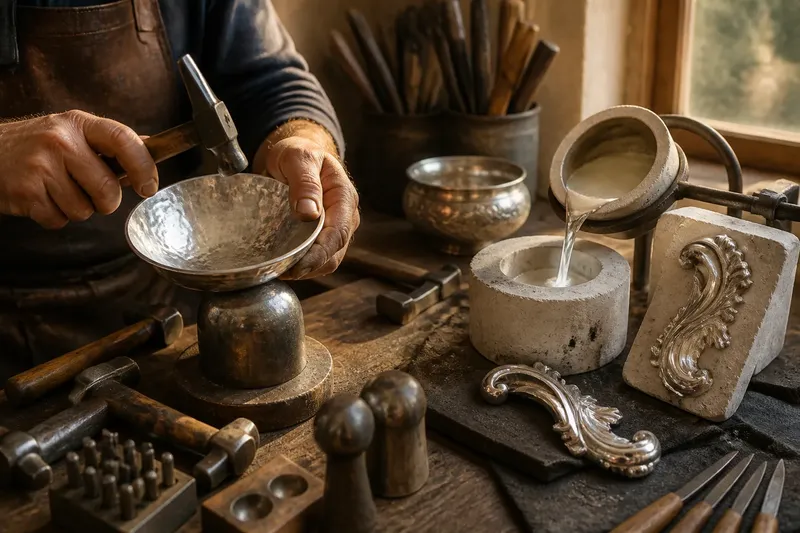
Hammered or cast silver starts with a practical choice: move a sheet into shape, or pour metal into a prepared cavity. That decision affects which forms are manageable, what traces may remain on the surface and where the maker can revise the design. A shallow dish can be raised from sheet; a sculpted handle with deep relief may be better suited to casting.
Neither method is simply “handmade” rather than “manufactured”. Hammer-forming can be highly controlled, and casting usually involves substantial hand-finishing. The distinction is how the silver takes shape, and what that route asks the maker to consider.
How is silver hammered into shape?
In hammer-forming, the maker starts with silver sheet or another workable blank and moves the metal by striking it against a support. The work may rest over a stake, a shaped metal tool, or a forming surface. A raising hammer can gradually draw a flat disc into a vessel; a planishing hammer can refine the contours and leave a more regular finish.
Metal does not behave like soft clay. Repeated working changes its properties and makes it harder to move. To restore workability, the maker may anneal the silver using a controlled heat treatment. The appropriate heating and cooling procedure depends on the alloy and workshop process; it is not a matter of assuming that any cooling method will do. Shaping and annealing can be repeated as the form develops.
Because the starting material is sheet, hammer-forming suits shapes that grow from a surface: bowls, cups, trays and rounded cases. The maker can adjust a curve, bring a rim into line or soften an uneven transition as the work progresses. Deep, narrow recesses and enclosed details can be harder to reach with a hammer and support.
How does casting make a silver object?
Casting begins with a cavity shaped for the intended object. Molten silver enters the cavity and solidifies as it cools. In lost-wax casting, a wax model is surrounded by investment; heating removes the wax and leaves a space for the metal. Other moulding approaches use different materials and procedures.
Casting can suit forms that would be awkward to raise from sheet, including rounded relief, deep recesses and complex silhouettes. Wax lets the maker model curves and details before casting. The mould and the metal’s flow still impose limits, so a design may need changes to fill the cavity and allow the finished piece to be removed.
The cast piece usually needs further work. The maker removes casting channels and sprues, cleans the surface, checks the shape and refines details with files, gravers or abrasives. Pits, seams and softened edges may need attention. The finishing choices determine how much of the original cast texture remains visible.
What does each method ask the maker to plan?
Hammer-forming makes the path of the tool part of the design. The maker considers how to reach each area, how much the silver can move and where the form needs support. A broad curve may be easier to develop than a shape with abrupt changes of direction. The silhouette can be adjusted during the work, but each change must suit the metal’s behaviour.
Casting shifts more of the design work to the model and mould. The maker can plan the object as a volume, including surfaces that would be difficult to reach from outside. The mould must release the finished piece, and sections of different thickness can cool differently. The design may therefore need revision to help metal flow and make finishing possible.
The difference is like shaping a sheet of paper over a bowl versus pressing dough into a mould: one starts with a surface and bends it into volume; the other starts with a boundary for the volume. Silver is far less forgiving than either everyday material, but the comparison captures the basic design choice.
What surface clues can hammering or casting leave?
A hammered surface may retain small facets, repeated planishing marks or subtle changes in curvature. The eye can follow the changing planes, and the hand may notice a lively surface. Hammering does not always leave an obvious texture: careful planishing and polishing can make the marks difficult to see.
A cast surface may preserve details from the mould or model, such as raised ornament or recessed pattern. Finishing can leave evidence around joins, gates or difficult transitions. A polished cast object can look smooth and precise; a maker may also leave some texture visible. No single surface feature establishes how an object was made or whether it is well made.
Look at transitions rather than treating one mark as a verdict. Does the rim meet the body cleanly? Are details crisp where they should be? Do changes in surface make sense with the shape? These observations can help describe an object, but appearance alone may not reveal its full production history.
Which method suits the design you have in mind?
Geometry, the intended surface and the kind of adjustment the maker wants to retain all matter. Use these points to frame a choice, not as fixed rules:
- Observation: The design is a broad vessel with a continuous curve. If the curve can be formed from sheet, then consider hammer-forming; otherwise, revise the shape or consider casting.
- Observation: The design has deep relief or an intricate profile. If the features cannot be reached readily with hammer and support, then consider casting; otherwise, compare the effort and finish required for both routes.
- Observation: The silhouette is likely to change as the work develops. If those changes can be made by moving sheet, then hammer-forming may suit the process; otherwise, revise the model before casting.
- Observation: The design needs repeated versions of a prepared form. If a mould can accommodate the design, then consider casting; otherwise, assess whether another forming method better fits the shape.
- Observation: The object combines a simple body with a detailed ornament. If the parts can be joined appropriately, then consider a mixed approach; otherwise, redesign the junction or form the object as one piece by a suitable method.
- Observation: The intended surface depends on visible tool marks. If those marks are part of the design, then plan to retain and finish them deliberately; otherwise, allow for finishing that reduces their visibility.
A small cast form can be plain, and a hammered object can be elaborate. The method is one part of the design brief, alongside the object’s purpose, the intended surface and the maker’s skill.
How can you distinguish hammered or cast silver?
Does a hammered object always show hammer marks?
No. Planishing, filing and polishing can reduce visible marks, while some makers deliberately leave them. Curvature and transitions may offer clues, but no single visual feature settles the question.
Can casting produce a smooth finish?
Yes. Filing, polishing and other finishing can make a cast object appear smooth. Close inspection may reveal details at joins or complex edges, but a smooth surface alone does not establish how the object was formed.
Can one silver object use both methods?
Yes. A maker might cast a knob, foot or decorative element and join it to a body formed from sheet. The finished object can therefore reflect more than one method.
Which method makes a stronger object?
There is no universal answer from the method alone. Strength depends on the design, alloy, thickness, joins, workmanship and intended use; a particular piece may need assessment by a qualified silversmith.
How might a maker combine the methods?
Imagine a maker planning a small silver bowl with a gently curved body and a sculpted bird for a handle. The maker first checks whether the bowl’s profile can be raised from sheet and whether the bird can be modelled and cast as a separate part. If the proposed bird and its junction can be cast, finished and joined suitably, the maker could raise the bowl, cast the bird separately, then assess and refine the join. The expected result would combine a body formed from sheet with a separately made handle; the design might need revision if the junction or casting details prove unsuitable.
When you compare hammered or cast silver, ask how the chosen method serves the shape: where the curves travel, how details meet and which making traces remain visible. That question is more useful than trying to name a winner, especially when an object combines both routes.